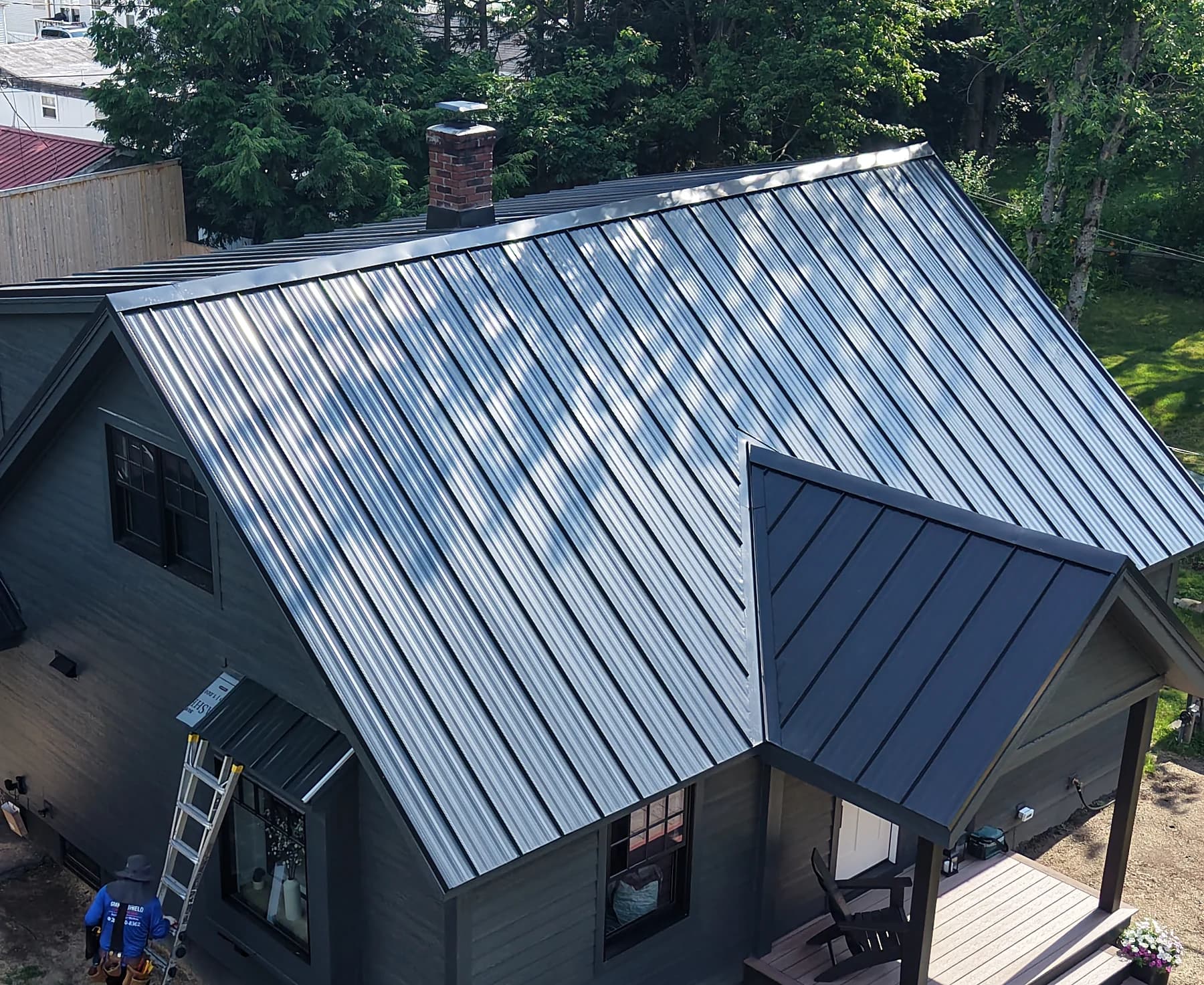
Standing Seam Metal Roofing in Southern Maine
Long-life metal roof systems engineered for Maine snow, wind, and coastal exposure — with clean transitions, correct flashing, and owner-run accountability.
Serving Southern Maine: Cumberland Center, Portland, Falmouth, Yarmouth, Freeport, Scarborough, Cape Elizabeth, South Portland, Westbrook and nearby towns.
System-Level Detailing Matters
Metal roofing is only as good as the detailing at transitions — walls, chimneys, valleys, and penetrations. We build the system, not just the panels.
Get a Clear Plan
We’ll inspect, explain options, and give you a clean estimate that’s built for Maine conditions.
Recent Standing Seam Installs
Our own crew on real Southern Maine roofs — panel details, in-progress installs, and finished planes from Brunswick and Gorham.
Engineered for Maine Snow and Ice
Southern Maine roofs carry some of the heaviest snow loads in the country, and they carry them for months at a time. Standing seam metal is one of the few roofing systems that turns that into an advantage: the smooth, vertical panel surface sheds snow instead of holding it, and the raised seams give the roof rigid, continuous structural lines from ridge to eave. Because the panels attach with concealed clips instead of thousands of exposed fasteners, there are no penetration points to work loose through Maine's freeze-thaw cycles — one of the most common causes of leaks on aging screw-down metal and shingle roofs. Snow load itself is a structural question before it's a roofing question, and the panel gauge, clip spacing, and fastening schedule all get selected against it rather than pulled from a one-size-fits-all spec.
Ice dams are the other Maine reality. A standing seam system doesn't stop ice dams by itself — that takes the full assembly underneath: ice and water protection at the eaves and valleys, a ventilation path that keeps the roof deck cold, and insulation coordination at the attic floor. We evaluate all three on every install and detail them as the roof and structure require — the same "as needed, when applicable" judgment listed in the checklist above, because not every home needs every layer. It's why our ice dam work so often turns into standing seam conversions: homeowners want the roof that stops the cycle, not another season of steaming.
Built for Coastal Wind and Salt
From Cape Elizabeth to Freeport, coastal exposure is a material problem before it's a workmanship problem. Salt air corrodes bare and poorly-coated steel, and nor'easter wind loads pry at every edge and fastener on a roof. That drives two decisions we weigh on every coastal standing seam job: the substrate and coating system — finishes chosen to resist the chalking and fade that coastal UV and salt air accelerate, matched to how close the site sits to open salt water — and the attachment system, with panels on concealed clips rated for wind uplift and trim and closures matched so dissimilar metals never touch and corrode each other.
Wind-driven rain gets the same treatment as wind itself: hemmed panel edges, sealed Z-closures at ridge and hips, and flashing details at walls and chimneys that assume water WILL arrive sideways. That's the difference between a metal roof that merely looks right on day one and one that's still tight after a decade of coastal storms.
The System Behind the Panels
The panels are the visible tenth of a standing seam roof. Under them, the system we install runs in layers, and every layer has a Maine-specific job:
- Deck and underlayment. A sound deck — repaired or refastened where inspection calls for it — under a high-temperature synthetic underlayment; metal roofs run hotter and shed condensation differently than shingles, so the underlayment has to be rated for it, with ice and water membrane at eaves, valleys, and penetrations as the roof requires.
- Clips and thermal movement. Metal expands and contracts with every temperature swing — across a Maine year that's a 120°F+ range. Concealed clips let each panel float through that movement instead of shearing fasteners, which is exactly what fixed screw-down systems can't do.
- Panel profile and seams. Mechanically seamed profiles for low-pitch and high-exposure planes; snap-lock where pitch and exposure allow. Standing seam panels run ridge-to-eave in continuous lengths — no horizontal laps to catch water.
- Flashing and ventilation. Custom-bent flashing at chimneys, walls, and skylights, and a vented ridge detail that keeps the deck cold in winter and sheds heat in summer. This is where roofs fail — so it's where we spend the time.
Wondering what a system like this costs for your home? Skip the guesswork — our instant quote measures your actual roof and prices metal and shingle options for your address in under a minute.
Standing Seam Across Southern Maine
We install standing seam metal roofing across all 35 Southern Maine towns we serve — recent installs include the matte black roof in Brunswick, an 18-square install in Gorham, and a full exterior in Freeport. Inland or coastal, the crew and the standard are the same — installed by our crew and inspected by the owner on every job. Whether your roof faces salt air in Cape Elizabeth or lake-effect snow in Bridgton, the assessment starts the same way: we measure, we look at the structure and the exposure, and we spec the system to the house in front of us.
Standing Seam Metal Roofing FAQs
Is standing seam metal roofing good for Maine?
Yes. Standing seam is highly durable and performs well with Maine snow, wind, and freeze-thaw cycles when detailed correctly at transitions and flashing points.
Do you install metal roofs in coastal towns?
Yes. Coastal exposure requires careful detailing for wind-driven rain and long-term performance. We build systems designed for Maine conditions.
How long does a standing seam roof last?
Metal systems can last for decades. Longevity depends on material, installation quality, and detailing at transitions and penetrations.
Do you install over existing shingles?
Sometimes. It depends on roof condition, layers, code requirements, and system design. We’ll recommend the safest long-term option after inspection.
Do I need snow guards on a standing seam roof in Maine?
Often, yes — above entries, walkways, decks, and lower roofs, sliding snow is a real hazard. Clamp-on snow guards attach to the seams without penetrating the panels, so the roof stays watertight while releases are controlled.
Is a metal roof loud in the rain?
Not on a residential system. Standing seam installs over a solid deck and underlayment — not open framing like a barn — so rain noise is comparable to an architectural shingle roof.
Standing Seam Metal Roofing across Southern Maine
We build for each town's conditions — coastal wind and salt air on the shore, deep snow loads and ice dams inland. See how we work where you live:
What does a roof cost in Maine?
It depends on your roof — size, pitch, layers, flashing, and the system you choose. Skip the guesswork: our instant quote measures your actual roof and prices metal and shingle options for your address in under a minute.
Free • No appointment • Metal & shingle options